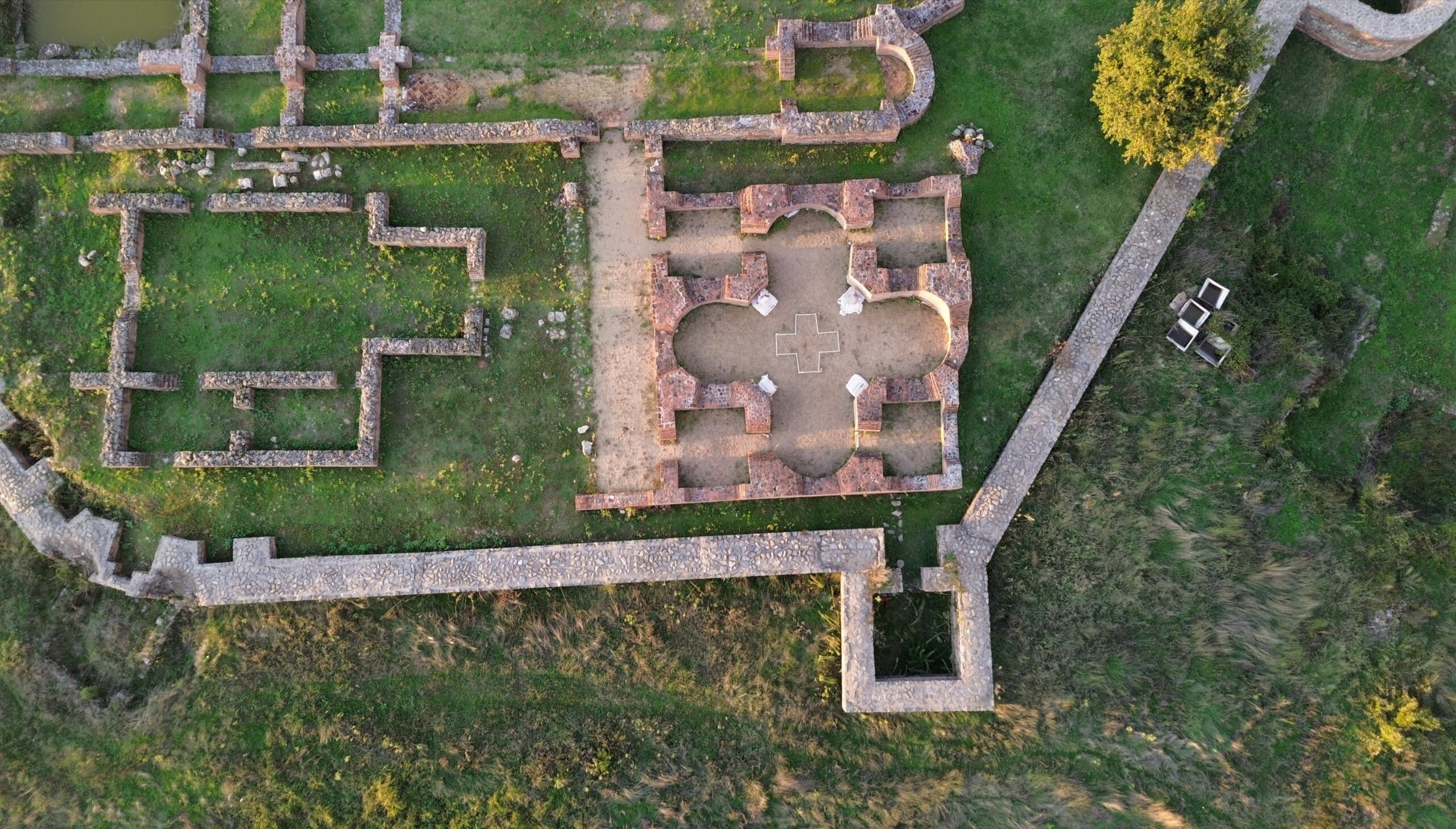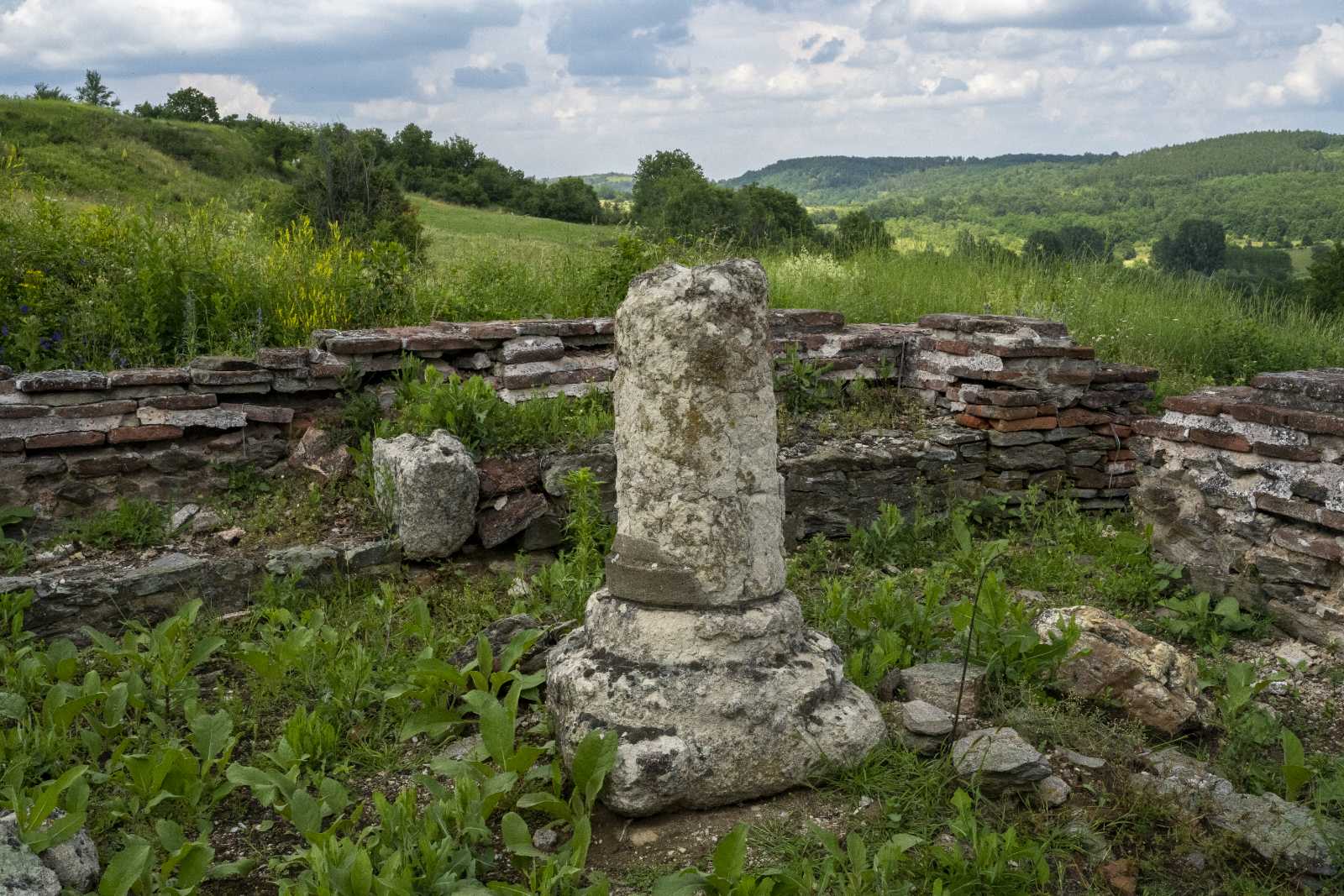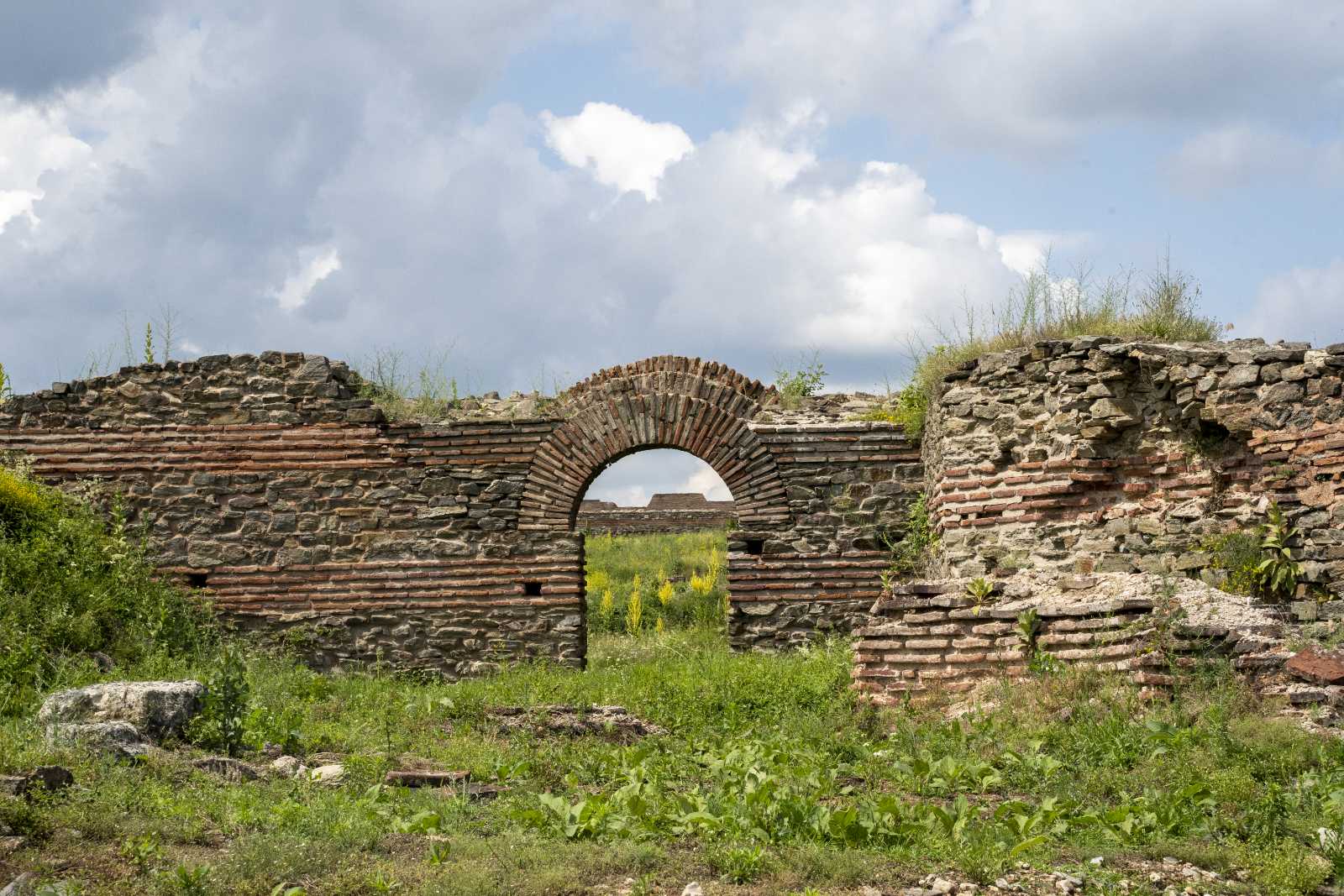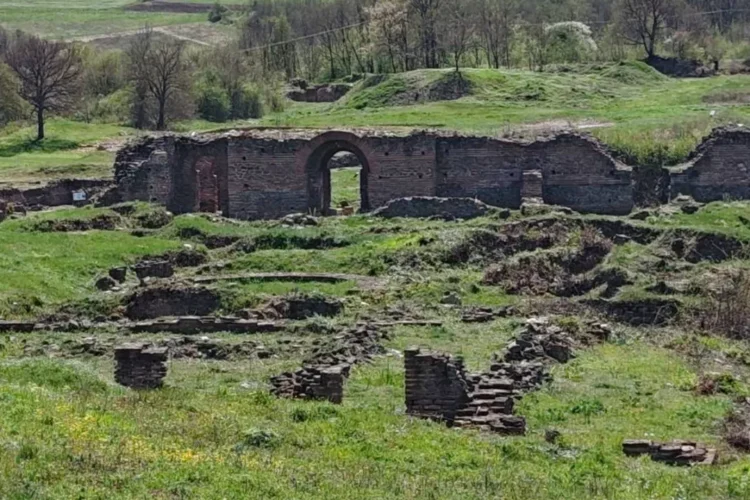
The archaeological site of Caričin Grad, covering an area of 40 hectares, consists of the remains of an early Byzantine city. The city’s patron was the Roman Emperor Justinian I, who, upon ascending the throne, founded a new seat of the Archbishopric for Northern Illyricum in Justiniana Prima in 535 AD, as a gesture of gratitude to his birthplace. The Archbishopric remained active for less than a century, after which the city was abandoned due to armed conflicts and the weakening of the Empire under Justinian’s successors.
The first organized archaeological excavations were launched in 1912 by the National Museum in Belgrade.
The inner urban core, surrounded by ramparts, spanned approximately 10 hectares, while the wider area covered more than 40 hectares. The site is characterized by an authentic urban layout typical of Roman Empire cities at the beginning of the Byzantine era—featuring main corridors, gates, forums, thermal baths, other public buildings, and remains of floor mosaics—all preserved in their original form as the site underwent no later additions. Numerous legends associated with this site are still told among the local people today.
The site is open to visitors year-round and is managed and maintained by the National Museum in Leskovac. Visitors arrive both in groups and individually, coming from Serbia as well as across the Balkans. Individual visitors include excursionists, couples, and families with children, while group visits consist of school excursions, various associations, retiree unions, and student groups of archaeology, law, history, and art history. The site also hosts military and church delegations, Byzantinists, archaeologists, journalists, and others.
The Episcopal Basilica is among the first monuments discovered at Caričin Grad, dating back to 1912. It is an impressive three-aisled, three-apsed church with a narthex and an atrium featuring a large piscina. The floors of the central nave, and likely the side aisles and narthex as well, were covered with mosaics. Adjoining the southern side of the basilica via a portico is a monumental baptistery, designed as a building with a square foundation.
The flattened plateau of the Acropolis is enclosed by a rampart reinforced with projecting horseshoe-shaped and rectangular towers. The entire area of the Acropolis, divided into two sections by a central street with porticos, served as a sacred space and the episcopal seat. A cathedral church with a baptistery and one smaller building was erected on the southern half, while the Episcopal Palace was located in the northern section.
The most developed area of Caričin Grad is the Upper Town (Gornji grad), which was protected by powerful ramparts. Their route, clearly visible in the terrain’s configuration, was positioned along the gentle slopes of the northern part of the ridge. The South Gate, defended by projecting pentagonal towers, served as the main entrance to the Upper Town for major traffic, while postern gates located on the opposite sides of the towers were designated for pedestrians. The western stretch of the southern rampart has been excavated from the inner side up to the corner water tower. This is an extraordinary structure with walls reinforced with waterproof mortar, representing the final destination of the aqueduct. Water accumulated in this reservoir and was further distributed through a system of lead pipes toward the northern part of the Upper Town.
The structure identified as the principia was essentially a three-aisled building constructed along the southern and western ramparts, to which it was connected by partition walls. The central building, featuring a ceremonial hall, ended in a rectangular apse. The entire complex was significantly expanded with the construction of two new wings—two elongated rooms intended for administration. At the same time, an atrium was formed, and a new entrance was created by cutting through the shops along the western portico.
One of the most representative buildings in Caričin Grad is the Basilica with a Transept, which stands out from other structures due to its well-preserved floor mosaics discovered in the nave. It is a three-aisled church with a narthex and an atrium. The walls of the basilica were richly decorated with marble slabs, wall mosaics, and frescoes. Its ornamentation is best evidenced by the floor mosaics preserved in the narthex and the central nave, as well as partially in the altar area. Among the numerous compositions, representations of the Good Shepherd, hunting scenes, warriors, centaurs, Amazons and animals stand out. Among the many findings of stone plastics, a special place is held by a fragmented Ionic impost capital with the engraved Latin monogram of Emperor Justinian I (527–565).